Search: cavalier/info-lgs@agrotis.it/info-lgs@agrotis.it – Page 6

Need a new search?

If you didn't find what you were looking for, try a new search!

Sindrome di Ehlers-Danlos di tipo 1 – Gatto di tutte le razze

Ehlers-Danlos syndrome (EDS) Type I is most likely caused by a mutation in the COL5A1 gene. This results in defective collagen synthesis or impaired assembly of the collagen structure. Collagen is the main component of connective tissue, and it is the most abundant protein in mammals. It is mostly found in tendons, ligaments, and skin, but also in bones, blood vessels and many other tissues.
Colore del mantello Locus-G (guanti bianchi) – Birmano

I gatti Birmani hanno i piedi bianchi chiaramente definiti (“guanti”) come parte del loro standard di razza. Questo caratteristico guanto è causato da una variante del gene KIT ed è ereditato come carattere autosomico recessivo. Un gatto deve avere due copie della mutazione per avere i piedi bianchi guantati. Oltre ai gatti birmani, questa variante genetica si presenta con frequenze più basse in altre razze senza portare al tipico guanto birmano.

Cerebellar Ataxia (CA1, RALGAPA1-related) – Belgian Shepherd

Cerebellar Ataxia (CA1) is a neurodevelopmental disorder. It is caused by an autosomal recessive mutation in the Ral GTPase activating protein, alpha subunit 1(RALGAPA1) gene. This gene is involved in the regulation of the activity of two small proteins, RALA and RALB. This regulation is crucial for controlling cellular processes such as growth, migration, and especially neuronal development. RALGAPA1 is highly expressed in areas of the brain that are essential for motor coordination. The mutation causes disruption of normal neuronal signalling and resulting in cerebellar ataxia in specific Belgian shepherd dogs.

Gene delle prestazioni del piccione DRD4-1 Bst4CI

Dopamine is a so-called neurotransmitter. Many important physiological functions are mediated by dopamine and its receptors. The dopamine receptor type 4 (DRD4) gene has been scientifically proven to influence the racing performance of pigeons, making it a useful performance marker.

There are two point mutations in this gene: DRD4-Bst4CI (also known as DRD4-1 or DRD4a) and DRD4-MnlI (also known as DRD4-2 or DRD4b).
In this the DRD4-Bst4CI mutation is analysed, which has been linked to enhanced orientation and initiative. This mutation has a strong positive effect on races up to 600 km, particularly in heterozygous individuals. The other mutation is available as a separate test.

Gene delle prestazioni del piccione DRD4-2 MnLI

Dopamine is a so-called neurotransmitter. Many important physiological functions are mediated by dopamine and its receptors. The dopamine receptor type 4 (DRD4) gene has been scientifically proven to influence the racing performance of pigeons, making it a useful performance marker.

There are two point mutations in the gene: DRD4-Bst4CI (also known as DRD4-1 or DRD4a) and DRD4-MnlI (also known as DRD4-2 or DRD4b).
In this test the presence of the DRD4-MnlI mutation is analysed. This mutation appears to influence character and perseverance, leading to improved performance in long-distance races in heterozygous individuals. The other mutation is available as a separate test.

Polineuropatia (LPN1)

A hereditary vorm of polyneuropathy (PN) is a disorder seen in Leonbergers and Saint Bernards. It affects the peripheral nerves and is similar to Charcot-Marie-Tooth (CMT) disease in humans. This severe, progressive condition usually starts in young dogs and leads to reduced exercise tolerance, gait problems, muscle loss in the hind limbs, and sometimes noisy or labored breathing due to malfunction of the nervous system. This form of PN is caused by a recessive mutation in the ARHGEF10 gene.

Malattia di Startle – American Shepherd miniatura

Startle Disease, also known as hyperekplexia, is a neurological disorder. Its main symptom is an exaggerated startle response that can result in episodes of sudden stiffness and collapse. The specific variant of the disorder analysed in this test is found in the Miniature American Shepherd. It is caused by a recessive mutation to the gene GLRA1.

H-Locus (Harlequin)

The 20S proteasome β2 subunit (PSMB7) gene is responsible for the Harlequin coat pattern in Great Danes. This gene is also known as H-Locus. Harlequin is a pattern resulting from interaction of the Merle (M-locus) gene and the Harlequin (H-locus) gene on black pigment. The Harlequin gene can modify the Merle gene. The Harlequin pattern is only expressed if on the M-locus at least one copy of the M allele is present in combination with at least one copy of the E or Em allele on the E-locus. Dogs that are not merle, or only have red pigment, cannot express the Harlequin gene. The dominant Merle gene, by itself produces dark spots on a diluted background. If a Merle dog also inherits one copy of the Harlequin gene, the dark spots increase in size and the background pigment is removed (turns white). The Harlequin mutation in Great Danes is in homozygous state (two copies of the mutation) considered embryonic lethal as no live dogs with two copies of the mutation have been observed. This means that pups that are homozygous for the Harlequin mutation do not develop in the uterus and are reabsorbed very early in the development process. Therefore all Harlequin patterned dogs have only 1 copy of the Harlequin mutation. The Coat colour H-locus (Harlequin) test (H316) tests for the genetic status of the H-locus. This gene has two variants (alleles), H and N. The allele H is dominant. One copy of the H allele, together with at least one copy of both the M allele for the M-locus and the E allele for the E-locus results in dogs with the Harlequin pattern. Two copies of the H allele result in early embryonic death. The allele N does have no effect on the coat colour.

The Coat colour H-locus (Harlequin) test encloses the following results.

H-Locus Coat Colour
N/N No Harlequin pattern unless modified by other colour modifying factors, only allele N will be passed on to an offspring
N/H Harlequin mutation is present. In order to express the Harlequin pattern the dog must carry at least one copy of both the M-allele for the M-locus and the E-allele for the E-locus. Either allele N or P will be passed on to an offspring

Parentage Verification using single nucleotide polymorphisms (SNPS)

As with STRs, the basis is the same. However, more genetic markers are tested because the information content per markers is lower for SNPs.

The genetic variation which is present in an animal, originates from both parents. Half of the variation is originating from the father, whereas the other half comes from the mother.

For parentage verification, typically 200 up to 400 genetic characteristics are visualized. In this process the actual genetic composition (A,C,G, or T) is being measured. The composition/variant  in an offspring must correspond to the composition/variant in the mother and father that were provided for comparison. In two examples, it is shown how the basic rules are applied in parentage verification.

Marker

Offspring

Mother

Father

SNP01

AT

AA

TT

SNP02

GC

GC

CC

SNP03

TT

CT

TT

SNP04

AC

AC

AC

SNP05

CC

CC

CT

SNP06

CT

CC

CT

In the above table an example is provided of a correct parentage. In this table, the DNA is shown of three individuals: an offspring (left column), a potential mother (middle column), and a potential father (right columns). In each line one variant is shown. In this case all variants in the offspring are present in the parents: the parentage is correct.

Marker

Offspring

Mother

Father

SNP01

AA

AA

TT

SNP02

GC

GC

CC

SNP03

CC

CT

TT

SNP04

AC

AC

AC

SNP05

CC

CC

CT

SNP06

CT

CC

CT

In the second table an example is provided of an incorrect parentage. In this table, the DNA is shown of three individuals: an offspring (left column), a potential mother (middle column), and a potential father (right columns). In each line one variant is shown. In this case several variants are present in the offspring which are not are present in the parents: the parentage is not correct.

When 200 up to 400 different genetic fragments are checked, the chance that an incorrect parentage is not detected becomes very small. The genetic fragments which are used for parentage verification and identification provide no information on properties such as color and quality of an animal, plant or human, since the fragments are non-coding.

CombiBreed Dati SNP Fit2Breed

By ordering this product, you authorize us to share the 35000 SNP data (your dog’s genetic results) linked to the chip number with Utrecht University, our research partner. This data will be used to update your profile in the Fit2Breed database and to enable Utrecht University to conduct anonymized scientific research. The data transfer occurs automatically, and no status updates will be provided.

For more information about the collaboration between Fit2Breed and the Vereniging Het Nederlandse Kooikerhondje, please visit their website.
To order this package, we recommend using this link to Utrecht University. There, you can easily provide the required information for Fit2Breed and complete the ordering process.

Gruppi Sanguigni del gatto – K300 / K712 / K793

Introduzione
Nei gatti esistono diversi tipi di gruppi sanguigni, tra i quali il sistema AB è il più importante. In questo sistema, i gatti possono avere il tipo A, B o AB.
La presenza di alte quantità di anticorpi anti-A naturalmente presenti nei gatti di tipo B porta all’esplosione dei globuli rossi di tipo A quando entrano in contatto con il sangue di tipo B. Questo avviene ad esempio nella isoeritrolisi neonatale (NI). La NI può verificarsi quando una fattrice di tipo B si accoppia con un maschio di tipo A e dà alla luce gattini di tipo A. Durante i primi giorni di vita, i gattini assorbono gli anticorpi anti-tipo A prodotti dalla fattrice di tipo B. Ciò provoca l’esplosione dei globuli rossi di tipo A del gattino, causando anemia, che può essere letale. È quindi importante per gli allevatori testare il tipo di sangue delle fattrici di riproduzione per identificare il rischio di NI e ridurre al minimo le possibilità di mortalità neonatale.

I test genetici K793 e K300
Il test genetico K793, disponibile per tutte le razze*, identifica due tipi di alleli recessivi b che sono associati al Gruppo Sanguigno B. Analizzando insieme queste due mutazioni, è possibile predire il gruppo sanguigno B nei gatti. Poiché devono ancora essere identificate ulteriori mutazioni, esiste la possibilità che i risultati genetici di questo test non corrispondano ai risultati convenzionali della tipizzazione sanguigna (sierologia).
Il test genetico K300, disponibile per i Ragdoll, identifica una variante dell’allele AB ed è associato al Gruppo Sanguigno AB nei gatti Ragdoll. Poiché i gatti di tipo AB di altre razze non hanno la variante di tipo AB dei Ragdoll che viene analizzata con il test genetico K300, deve essere presente almeno un’altra variante che comporti anche Gruppo Sanguigno AB in altre razze di gatti. Questa variante deve ancora essere identificata.

Test sierologico K712
Un altro metodo per identificare i tipi di sangue dei gatti è la sierologia. Questo metodo non fornisce informazioni sulla genetica in modo diretto e quindi non è adatto per essere utilizzato come unico metodo nella scelta degli accoppiamenti. Quando i test genetici (K300 e/o K793) forniscono un risultato inconcludente (tipo A o AB), il test sierologico può essere utilizzato per distinguere tra sangue di tipo A o tipo AB.
La tipizzazione sanguigna sierologica viene utilizzata principalmente per le trasfusioni di sangue e può essere eseguita solo su sangue intero (EDTA o eparina).

Interpretazione dei risultati
I gatti con due copie di uno qualsiasi dei due alleli b hanno il Gruppo Sanguigno B. I gatti con una copia di uno qualsiasi dei due alleli b e quindi portatori di b, possono avere il gruppo sanguigno A o AB, a seconda del secondo allele presente.

I Ragdoll con due copie dell’allele AB hanno il sangue di tipo AB. I Ragdoll con una copia dell’allele AB e quindi portatori di AB possono avere il sangue di tipo A o AB, a seconda del secondo allele presente.

Si prega di notare che non è possibile distinguere tra il tipo A o AB con i nostri test genetici quando viene eseguito solo il test K300 (solo per i Ragdoll) o il test K793. Per fare una distinzione tra il sangue di tipo A o AB, si può utilizzare il test sierologico K712. Per i Ragdoll, per ottenere il risultato più accurato, si consiglia di eseguire sia il test K300 che il test K793.

Gruppo Sanguigno (tutte le razze *) – K793

Risultato Genetico Genotipo Interpretazione
Nessun allele b N/N Il gatto ha Gruppo sanguigno A or AB **
Una copia di allele b N/b Il gatto ha Gruppo sanguigno A or AB **
Due copie di allele b b/b Il gatto ha Gruppo sanguigno B
Inconcludente Non è possibile determinare il gruppo sanguigno, il gatto ha il sangue di tipo A, B o AB. Il test sierologico K712 può fornire informazioni aggiuntive.

Gruppo Sanguigno (Ragdoll) – K300

Risultato Genetico Genotipo Interpretazione
Nessun allele AB N/N Il gatto ha Gruppo sanguigno A or B ***
Una copia dell’allele AB N/AB Il gatto ha Gruppo sanguigno A or AB ***
Due copie dell’allele AB AB/AB Il gatto ha Gruppo sanguigno AB

Gruppo Sanguigno (Ragdoll) – K300 e K793 combinati

Risulato K300 Risultato K793 Interpretazione
N/N N/N Il gatto ha Gruppo sanguigno A
N/AB N/N Il gatto ha Gruppo sanguigno A
AB/AB N/N Il gatto ha Gruppo sanguigno A
N/N N/b Il gatto ha Gruppo sanguigno A
N/AB N/b Il gatto ha Gruppo sanguigno AB
N/N b/b Il gatto ha Gruppo sanguigno B

*Alcune razze come Siamesi, Burmesi e Orientali a pelo corto non hanno l’allele b

** Si prega di notare che non è possibile distinguere tra il sangue di tipo A o AB con i nostri test genetici. Per fare una distinzione tra il sangue di tipo A o AB, si può utilizzare il test sierologico K712 per fornire informazioni aggiuntive.

*** Si prega di notare che non è possibile distinguere tra il sangue di tipo A o B solo con il test genetico K300 nei Ragdoll, il test genetico K793 può essere utilizzato per fornire informazioni aggiuntive.

Servizi DNA

DNA Services Dog

Cane – Genotipizzazione dell’intero genoma

Per quel che riguarda i BeadChips per la genotipizzazione Illumina, esistono diverse opzioni. Grazie alla nostra collaborazione con Geneseek, siamo in grado di offrire una vasta gamma di BeadChip, compresi i prodotti personalizzati e la gamma regolare di chip Illumina. Inoltre, siamo in grado di offrire un set personalizzato, dedicato alle tue esigenze.

La maggior parte di Illumina BeadChips ha un formato per 24 campioni. Per questo test é necessario inviare gruppi di 24 campioni.

A seconda del prezzo del cliente, una nuova esecuzione può o non può essere inclusa automaticamente. Ciò dipende inoltre dal tipo di campione, dalla qualità e dalla quantità del campione o del DNA inviato. Per vostra informazione, siamo in grado di eseguire BeadChips utilizzando quasi tutti i tipi di campioni.

Cavallo – Equino SNP70 (GGP)

Il Beadchip Equino SNP70 è un chip denso che copre l’intero genoma del cavallo con 65k SNP uniformemente distanziati. Il chip è uno strumento adatto per consentire l’identificazione di geni e polimorfismi che contribuiscono a tratti di interesse in tutte le principali razze equine.

Per quel che riguarda i BeadChips per la genotipizzazione Illumina, esistono diverse opzioni. Grazie alla nostra collaborazione con Geneseek, siamo in grado di offrire una vasta gamma di BeadChip, compresi i prodotti personalizzati e la gamma regolare di chip Illumina. Inoltre, siamo in grado di offrire un set personalizzato, dedicato alle tue esigenze.

La maggior parte di Illumina BeadChips ha un formato per 24 campioni. Per questo test é necessario inviare gruppi di 24 campioni.

A seconda del prezzo del cliente, una nuova esecuzione può o non può essere inclusa automaticamente. Ciò dipende inoltre dal tipo di campione, dalla qualità e dalla quantità del campione o del DNA inviato. Per vostra informazione, siamo in grado di eseguire BeadChips utilizzando quasi tutti i tipi di campioni.

DNA Services Horse

Parentage Verification using microsatellites (STRS)

STR yes
STR no

The genetic variation which is present in an animal, originates from both parents. Half of the variation is originating from the father, whereas the other half comes from the mother.

For parentage verification, typically 20 up to 40 genetic characteristics are visualized. In this process the length of genetic fragments is being measured. The measured length of a genetic characteristic in an offspring must correspond to the length in the mother and father that were provided for comparison. In two examples, it is shown how the basic rules are applied in parentage verification.

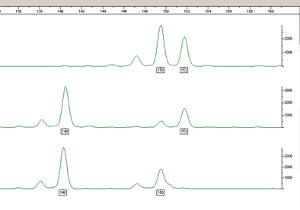
In the figure an example is provided of a correct parentage. In this figure, the DNA is shown of three individuals: an offspring (upper line), a potential mother (middle line), and a potential father (bottom line). In each line one genetic marker is shown. Two DNA fragments are visible as peaks. The first fragment of the offspring is originating from the father (length of the fragment is 150), whereas the second fragment comes from the mother (fragment length 152). In this case both fragments of the offspring are present in the parents: the parentage is correct.

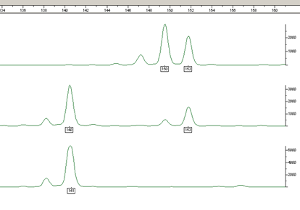
In the second example a situation is shown where parentage does not qualify. The three lines are shown in the order of offspring, potential mother and potential father. Again in each line one DNA marker is shown, where two DNA fragments are visible as peaks. The second fragment of the offspring is present in the mother (fragment length 152), whereas the first fragment in the offspring (fragment length 150) is NOT present at the assigned father. In this case, one fragment is present at the offspring, which is not present in either of the parents: the parentage does not qualify.

When 20 up to 40 different genetic fragments are checked, the chance that an incorrect parentage is not detected becomes very small. The genetic fragments which are used for parentage verification and identification provide no information on properties such as color and quality of an animal, plant or human, since the fragments are non-coding.

When the length of a number of DNA fragments is measured for a sample, a DNA-profile is established. This pattern is unique for a specific individual person, animal or plant, so that in cases of doubt DNA-profiles can be compared to confirm if two samples originate from the same individual.

Coat Colour Gold (Copper, Sunshine, Extreme Sunshine)

In British Shorthair and Siberian cats, the Gold phenotype is a colour modification of a typical striped tabby coat, lightening it to shades of yellow and orange. The phenotype can be caused by one of several different mutations to the Corin serine peptidatse (CORIN) gene: Sunshine, Extreme Sunshine and Copper.
The three ‘Golden’ mutations are included in this DNA test. Information on the individual tests is available through the links at the DNA tests.

Profilo del DNA – Piccione

Questo prodotto contiene un profilo del DNA di un singolo animale.

Un profilo del DNA viene stabilito utilizzando i marcatori del DNA. Il profilo di ogni campione viene memorizzato in un database e può essere rappresentato come un codice a barre, univoco per ogni individuo. Questo profilo del DNA ha lo scopo di verificare la parentela, che comporta un confronto delle informazioni genetiche presenti in una prole con quelle dei potenziali genitori. Per un’accurata verifica della parentela, tutte le informazioni genetiche nella prole devono essere riconducibili alla combinazione della madre e del padre. Nella maggior parte dei casi, l’affidabilità di questa analisi supera il 99,5%.

Oltre alla verifica della parentela, un profilo del DNA può essere utilizzato per confermare l’identità di un individuo. L’affidabilità di tale analisi è estremamente elevata, in quanto richiede una corrispondenza esatta di tutte le informazioni genetiche tra due campioni.

DNA profile Horse – Icelandic Horse

Questo prodotto produce un profilo del DNA per un singolo cavallo.
Un profilo del DNA viene stabilito utilizzando i marcatori del DNA. Il profilo di ogni campione viene memorizzato in un database e può essere rappresentato come un codice a barre, univoco per ogni individuo. Questo profilo del DNA ha lo scopo di verificare la parentela, che comporta un confronto delle informazioni genetiche presenti in una prole con quelle dei potenziali genitori. Per un’accurata verifica della parentela, tutte le informazioni genetiche nella prole devono essere riconducibili alla combinazione della madre e del padre. Nella maggior parte dei casi, l’affidabilità di questa analisi supera il 99,5%.
Oltre alla verifica della parentela, un profilo del DNA può essere utilizzato per confermare l’identità di un individuo. L’affidabilità di tale analisi è estremamente elevata, in quanto richiede una corrispondenza esatta di tutte le informazioni genetiche tra due campioni.

Profilo del DNA Cavallo

Questo prodotto produce un profilo del DNA per un singolo cavallo.
Un profilo del DNA viene stabilito utilizzando i marcatori del DNA. Il profilo di ogni campione viene memorizzato in un database e può essere rappresentato come un codice a barre, univoco per ogni individuo. Questo profilo del DNA ha lo scopo di verificare la parentela, che comporta un confronto delle informazioni genetiche presenti in una prole con quelle dei potenziali genitori. Per un’accurata verifica della parentela, tutte le informazioni genetiche nella prole devono essere riconducibili alla combinazione della madre e del padre. Nella maggior parte dei casi, l’affidabilità di questa analisi supera il 99,5%.
Oltre alla verifica della parentela, un profilo del DNA può essere utilizzato per confermare l’identità di un individuo. L’affidabilità di tale analisi è estremamente elevata, in quanto richiede una corrispondenza esatta di tutte le informazioni genetiche tra due campioni.

Profilo del DNA del gatto – SNP (ISAG 2020)

Questo prodotto contiene un profilo del DNA di un singolo animale.

Un profilo del DNA viene stabilito utilizzando i marcatori del DNA. Il profilo di ogni campione viene memorizzato in un database e può essere rappresentato come un codice a barre, univoco per ogni individuo. Questo profilo del DNA ha lo scopo di verificare la parentela, che comporta un confronto delle informazioni genetiche presenti in una prole con quelle dei potenziali genitori. Per un’accurata verifica della parentela, tutte le informazioni genetiche nella prole devono essere riconducibili alla combinazione della madre e del padre. Nella maggior parte dei casi, l’affidabilità di questa analisi supera il 99,5%.

Oltre alla verifica della parentela, un profilo del DNA può essere utilizzato per confermare l’identità di un individuo. L’affidabilità di tale analisi è estremamente elevata, in quanto richiede una corrispondenza esatta di tutte le informazioni genetiche tra due campioni.

Sono disponibili due tipi di marcatori per la profilazione del DNA e la verifica della parentela: marcatori STR (microsatelliti) e marcatori SNP. Questi marcatori si basano su tecnologie diverse e i loro risultati non sono intercambiabili. Se non sei sicuro della differenza tra questi set di marcatori, contattaci prima di ordinare un test per determinare quale tipo di marcatore è necessario per eseguire il profilo del DNA o la verifica della parentela.

Profilo del DNA del gatto – STR + SNP (ISAG 2020)

Questo prodotto contiene un profilo del DNA di un singolo animale.

Un profilo del DNA viene stabilito utilizzando i marcatori del DNA. Il profilo di ogni campione viene memorizzato in un database e può essere rappresentato come un codice a barre, univoco per ogni individuo. Questo profilo del DNA ha lo scopo di verificare la parentela, che comporta un confronto delle informazioni genetiche presenti in una prole con quelle dei potenziali genitori. Per un’accurata verifica della parentela, tutte le informazioni genetiche nella prole devono essere riconducibili alla combinazione della madre e del padre. Nella maggior parte dei casi, l’affidabilità di questa analisi supera il 99,5%.

Oltre alla verifica della parentela, un profilo del DNA può essere utilizzato per confermare l’identità di un individuo. L’affidabilità di tale analisi è estremamente elevata, in quanto richiede una corrispondenza esatta di tutte le informazioni genetiche tra due campioni.

Sono disponibili due tipi di marcatori per la profilazione del DNA e la verifica della parentela: marcatori STR (microsatelliti) e marcatori SNP. Questi marcatori si basano su tecnologie diverse e i loro risultati non sono intercambiabili. Se non sei sicuro della differenza tra questi set di marcatori, contattaci prima di ordinare un test per determinare quale tipo di marcatore è necessario per eseguire il profilo del DNA o la verifica della parentela.

Profilo del DNA del cane – ISAG 2006 (STR) + ISAG 2020 (SNP)

Questo prodotto contiene un profilo del DNA di un singolo animale.

Un profilo del DNA viene stabilito utilizzando i marcatori del DNA. Il profilo di ogni campione viene memorizzato in un database e può essere rappresentato come un codice a barre, univoco per ogni individuo. Questo profilo del DNA ha lo scopo di verificare la parentela, che comporta un confronto delle informazioni genetiche presenti in una prole con quelle dei potenziali genitori. Per un’accurata verifica della parentela, tutte le informazioni genetiche nella prole devono essere riconducibili alla combinazione della madre e del padre. Nella maggior parte dei casi, l’affidabilità di questa analisi supera il 99,5%.

Oltre alla verifica della parentela, un profilo del DNA può essere utilizzato per confermare l’identità di un individuo. L’affidabilità di tale analisi è estremamente elevata, in quanto richiede una corrispondenza esatta di tutte le informazioni genetiche tra due campioni.

Sono disponibili due tipi di marcatori per la profilazione del DNA e la verifica della parentela: marcatori STR (microsatelliti) e marcatori SNP. Questi marcatori si basano su tecnologie diverse e i loro risultati non sono intercambiabili. Se non sei sicuro della differenza tra questi set di marcatori, contattaci prima di ordinare un test per determinare quale tipo di marcatore è necessario per eseguire il profilo del DNA o la verifica della parentela.

Go to Top