
Search: cavalier/info-lgs@agrotis.it/page/15/info-lgs@agrotis.it

Need a new search?

If you didn't find what you were looking for, try a new search!

Coat Colour White Spotting – W15

The White Spotting coat colour pattern in horses can be caused by any in a wide array of related mutations. The resulting pattern can vary anywhere between white markings on the face and legs, up to a completely white coat. Depending on both breed and pattern, variants of the White Spotting phenotype may be referred to as Splashed White, Dominant White, Tobiano or Sabino, among others.

The specific variant analysed in this test, known as White Spotting 15 (W15), is caused by an incomplete dominant mutation to the gene KIT. It has been observed in the Arabian horse.
Distrofia Muscolare (MD) – Cavalier King Charles Spaniel

La distrofia muscolare (MD) è una malattia muscolare legata all’X, equivalente alla distrofia muscolare di Duchenne (DMD) nell’uomo. Il disturbo è grave e alla fine fatale e provoca un progressivo degrado dei muscoli del cane. È causata da una mutazione recessiva legata al cromosoma X del gene DMD.

La variante analizzata in questo test si trova nel Cavalier King Charles Spaniel, ed è talvolta nota come distrofia muscolare del Cavalier King Charles Spaniel (CKCS-MD).

Carenza MCAD – Cavalier King Charles Spaniel

L’acil-CoA deidrogenasi a catena media (MCAD) è un enzima che aiuta l’organismo a elaborare gli acidi grassi a catena media, costituendo una parte fondamentale del metabolismo di un animale. Una mutazione recessiva del gene ACADM causa un deficit di MCAD (MCADD). Ciò si traduce in un accumulo di acidi grassi a catena media, causando sintomi neurologici come affaticamento e convulsioni. Nei cani, la carenza di MCAD si riscontra nel Cavalier King Charles Spaniel.

Macrotrombocitopenia (MTC) – Cavalier King Charles Spaniel

Thrombocytopenia or macrothrombocytopenia (MTC) is a hereditary disorder characterized by a reduced number of blood platelets (thrombocytes), many of which are enlarged. Thrombocytes play an essential role in blood clotting (coagulation). Mutations in the ß1‑tubulin (TUBB1) gene have been identified as the cause of this reduction. Depending on the specific variant, symptoms may range from prolonged bleeding times to an apparently healthy animal.
The variant in this test occurs in the Cavalier King Charles Spaniel and is caused by a recessive mutation in TUBB1. This form is generally considered mild: affected dogs often show low platelet counts and enlarged platelets, but many remain clinically healthy without spontaneous bleeding problems.
A related mutation has been identified in the Norfolk Terrier and Cairn Terrier. This version is regarded as more severe, with affected dogs more likely to show clinical signs such as prolonged bleeding times, petechiae, or bruising.

CombiBreed Cavalier King Charles Spaniel

Questo pacchetto combinato è progettato per fornirti informazioni vitali sulla salute genetica, i tratti e la diversità del tuo cane e include test del DNA per numerose malattie e/o tratti importanti. Inoltre, calcoliamo anche il Coefficiente di Consanguineità (COI) e la percentuale di Eterozigosi del DNA del tuo cane. Il COI mostra il grado di consanguineità del tuo cane, mentre la percentuale di eterozigosi è una misura della diversità genetica individuale del tuo cane.

Le informazioni sui singoli test di questo pacchetto sono disponibili nella sezione “Test inclusi” di questa pagina. Accettiamo campioni da animali di qualsiasi età. Normalmente, il tempo di consegna dei test eseguiti presso le nostre strutture è di 10 giorni lavorativi dal ricevimento del campione. Per i test esternalizzati, i cosiddetti “laboratori esterni” o “laboratori esterni di brevetti”, il tempo di consegna è di almeno 20 giorni lavorativi dal ricevimento del campione. Si prega di notare che i 20 giorni lavorativi menzionati sono una stima, poiché i tempi di spedizione a questi laboratori esterni o strutture di brevetto possono variare a causa di ritardi imprevisti.

Alcuni test inclusi vengono eseguiti da un laboratorio esterno. CombiBreed si occupa della mediazione tra voi come cliente e il laboratorio esterno. In questi casi, CombiBreed non può essere ritenuta responsabile per il comportamento del cliente e/o dell’appaltatore.

Roan

Roan is a white patterning coat colour trait of intermixed white and coloured hairs in the body while the head, lower legs, mane and tail remain colored. Roan horses are born with the pattern, though it may not be obvious until the foal coat is shed. The white and coloured hairs are evenly mixed in horses that inherit the classic Roan gene, which can differentiate this from several mimic patterns called roaning. Roaning patterns tend to be uneven in the distribution of white hairs and the inheritance of roaning has not been defined. The mutation causing the Roan coat colour has not yet been identified. The Coat Roan test (P659) tests for DNA markers that are associated with Roan coat colour in several breeds, the DNA markers can be used to determine if a horse has the Roan mutation and how many copies. This test detects three variants (alleles), Rn, Rn* and N. The allele Rn is dominant. One or two copies of the Rn allele result in a Roan coat colour. The allele Rn* is very uncommon and not always associated with the Roan coat colour, this allele has only been observed in Tennessee Walking horses and Rocky Mountain horses. The allele N is recessive and does not have an effect on the basic colour.

The Coat Colour Roan test encloses the following results, in this scheme the results of the Coat Colour Roan test are shown in combination with the possible results for the tests that determine the basic Coat Colour (Coat Colour Chestnut and Coat Colour Agouti test):

Result Roan

Result Chestnut + Agouti

Coat Colour

Description

N/N

e/e + A/A, A/a or a/a


Chestnut, Sorrel


Not Roan. The basic colour chestnut/sorrel is not modified unless modified by other colour modifying genes. It can only pass on allele N to its offspring.

N/N

E/E or E/e + A/A or A/a

Bay, Brown

Not Roan. The basic colour bay/brown is not modified unless modified by other colour modifying genes. It can only pass on allele N to its offspring.

N/N

E/E or E/e + a/a

Black

Not Roan. The basic colour black is not modified unless modified by other colour modifying genes. It can only pass on allele N to its offspring.

Rn/N

e/e + A/A, A/a or a/a


Chestnut/sorrel Roan

One copy of the dominant Rn allele. The colour is chestnut/sorrel roan, unless modified by other colour modifying genes. It can pass on either allele N or Rn to its offspring.

Rn/N

E/E or E/e + A/A or A/a

Brown/bay Roan

One copy of the dominant Rn allele. The colour is brown/bay roan, unless modified by other colour modifying genes. It can pass on either allele N or Rn to its offspring.

Rn/N

E/E or E/e + a/a

Black Roan

One copy of the dominant Rn allele. The colour is black roan, unless modified by other colour modifying genes. It can pass on either allele N or Rn to its offspring.

Rn*/N

e/e + A/A, A/a or a/a

Chestnut/sorrel or Chestnut/sorrel Roan

One copy of the uncommon Rn* allele. The colour can be chestnut/sorrel or chestnut/sorrel roan, unless modified by other colour modifying genes. It can pass on either allele N or Rn* to its offspring.

Rn*/N

E/E or E/e + A/A or A/a

Brown/bay or Brown/bay Roan

One copy of the uncommon Rn* allele. The colour can be brown/bay or brown/bay roan, unless modified by other colour modifying genes. It can pass on either allele N or Rn* to its offspring.

Rn*/N

E/E or E/e + a/a

Black or Black Roan

One copy of the uncommon Rn* allele. The colour can be black or black roan, unless modified by other colour modifying genes. It can pass on either allele N or Rn* to its offspring.

Rn/Rn

e/e + A/A, A/a or a/a

Chestnut/sorrel Roan

Two copies of the dominant Rn allele. The colour is chestnut/sorrel roan, unless modified by other colour modifying genes. It can only pass on allele Rn to its offspring.

Rn/Rn

E/E or E/e + A/A or A/a

Brown/bay Roan

Two copies of the dominant Rn allele. The colour is brown/bay roan, unless modified by other colour modifying genes. It can only pass on allele Rn to its offspring.

Rn/Rn

E/E or E/e + a/a

Black Roan

Two copies of the dominant Rn allele. The colour is black roan, unless modified by other colour modifying genes. It can only pass on allele Rn to its offspring.

Rn/Rn*

e/e + A/A, A/a or a/a

Chestnut/sorrel Roan

One copy of the dominant Rn allele and one copy of the uncommon Rn* allele. The colour is chestnut/sorrel roan, unless modified by other colour modifying genes. It can pass on either allele Rn or Rn* to its offspring.

Rn/Rn*

E/E or E/e + A/A or A/a

Brown/bay Roan

One copy of the dominant Rn allele and one copy of the uncommon Rn* allele. The colour is brown/bay roan, unless modified by other colour modifying genes. It can pass on either allele Rn or Rn* to its offspring.

Rn/Rn*

E/E or E/e + a/a

Black Roan

One copy of the dominant Rn allele and one copy of the uncommon Rn* allele. The colour is black roan, unless modified by other colour modifying genes. It can pass on either allele Rn or Rn* to its offspring.

Rn*/Rn*

e/e + A/A, A/a or a/a

Chestnut/sorrel or Chestnut/sorrel Roan

Two copies of the uncommon Rn* allele. The colour can be chestnut/sorrel or chestnut/sorrel roan, unless modified by other colour modifying genes. It can only pass on allele Rn* to its offspring.

Rn*/Rn*

E/E or E/e + A/A or A/a

Brown/bay or Brown/bay Roan

Two copies of the uncommon Rn* allele. The colour can be brown/bay or brown/bay roan, unless modified by other colour modifying genes. It can only pass on allele Rn* to its offspring.

Rn*/Rn*

E/E or E/e + a/a

Black or Black Roan

Two copies of the uncommon Rn* allele. The colour can be black or black roan, unless modified by other colour modifying genes. It can only pass on allele Rn* to its offspring.

Dun dilution

The Dun dilution gene lightens the coat colour of the horse by lightening the body colour, leaving the head, lower legs, mane and tail undiluted. Dun is also typically characterized by “primitive markings”, allmost all dun horses possess at least the dorsal stripe, but the presence of the other primitive markings varies. Other common markings may include horizontal striping on the legs, transverse striping across the shoulders, and lighter guard hairs along the edges of a dark mane and tail. Dun diluted coat colour with primitive markings is considered the “wild-type” colour and is found in wild equids such as przewalski horses. Dun dilutes both red and black pigment, and the resulting colors range from apricot, golden, dark gray, olive and many more subtle variations. A horse can also carry mutations for other modifying genes which can further affect its coat colour. The Coat Colour Dun dilution test (P660) tests for the genetic status of the TBX3 gene. This gene has three variants (alleles); allele D is dominant over the alleles nd1 and nd2; allele nd1 is dominant over nd2. The dominant allele D results in Dun dilution with primitive markings. Allele nd1 does not dilute the coat colour of the horse, primitive markings are present but the expression is variable. Allele nd2 does not have an effect on the basic colour.

The Coat Colour Dun dilution test encloses the following results, in this scheme the results of the Coat Colour Dun dilution test are shown in combination with the possible results for the tests that determine the basic Coat Colour (Coat Colour Chestnut and Coat Colour Agouti test):

Result Dun dilution

Result Chestnut + Agouti

Coat Colour

Description

nd2/nd2

e/e + A/A, A/a or a/a


Chestnut, Sorrel. No primitive markings

Two copies of the nd2 allele. Coat colour is not diluted and primitive markings are absent. The basic colour chestnut/sorrel is not modified unless modified by other colour modifying genes. It can only pass on allele nd2 to its offspring.

nd2/nd2

E/E or E/e + A/A or A/a

Bay, Brown. No primitive markings

Two copies of the nd2 allele. Coat colour is not diluted and primitive markings are absent. The basic colour bay/brown is not modified unless modified by other colour modifying genes. It can only pass on allele nd2 to its offspring.

nd2/nd2

E/E or E/e + a/a

Black. No primitive markings

Two copies of the nd2 allele. Coat colour is not diluted and primitive markings are absent. The basic colour black is not modified unless modified by other colour modifying genes. It can only pass on allele nd2 to its offspring.

nd1/nd2

e/e + A/A, A/a or a/a


Chestnut, Sorrel. Primitive markings may be present

One copy of the nd1 allele and one copy of the nd2 allele. The nd1 allele is dominant over the nd2 allele. Coat colour is not diluted. Primitive markings may be present. The colour can be further modified by other colour modifying genes. It can pass on either allele nd1 or nd2 to its offspring.

nd1/nd2

E/E or E/e + A/A or A/a

Bay, Brown. Primitive markings may be present

One copy of the nd1 allele and one copy of the nd2 allele. The nd1 allele is dominant over the nd2 allele. Coat colour is not diluted. Primitive markings may be present. The colour can be further modified by other colour modifying genes. It can pass on either allele nd1 or nd2 to its offspring.

nd1/nd2

E/E or E/e + a/a

Black. Primitive markings may be present

One copy of the nd1 allele and one copy of the nd2 allele. The nd1 allele is dominant over the nd2 allele. Coat colour is not diluted. Primitive markings may be present. The colour can be further modified by other colour modifying genes. It can pass on either allele nd1 or nd2 to its offspring.

nd1/nd1

e/e + A/A, A/a or a/a


Chestnut, Sorrel. Primitive markings may be present

Two copies of the nd1 allele. Coat colour is not diluted. Primitive markings may be present. The colour can be further modified by other colour modifying genes. It can only pass on allele nd1 to its offspring.

nd1/nd1

E/E or E/e + A/A or A/a

Bay, Brown. Primitive markings may be present


Two copies of the nd1 allele. Coat colour is not diluted. Primitive markings may be present. The colour can be further modified by other colour modifying genes. It can only pass on allele nd1 to its offspring.

nd1/nd1

E/E or E/e + a/a

Black. Primitive markings may be present


Two copies of the nd1 allele. Coat colour is not diluted. Primitive markings may be present. The colour can be further modified by other colour modifying genes. It can only pass on allele nd1 to its offspring.

D/nd2

e/e + A/A, A/a or a/a


Red dun. With primitive markings

One copy of the dominant D allele and one copy of the nd2 allele. Coat colour is dun-diluted with primitive markings. The colour can be further modified by other colour modifying genes. It can pass on either allele D or nd2 to its offspring.

D/nd2

E/E or E/e + A/A or A/a

Bay dun. With primitive markings

One copy of the dominant D allele and one copy of the nd2 allele. Coat colour is dun-diluted with primitive markings. The colour can be further modified by other colour modifying genes. It can pass on either allele D or nd2 to its offspring.

D/nd2

E/E or E/e + a/a

Blue dun. With primitive markings

One copy of the dominant D allele and one copy of the nd2 allele. Coat colour is dun-diluted with primitive markings. The colour can be further modified by other colour modifying genes. It can pass on either allele D or nd2 to its offspring.

D/nd1

e/e + A/A, A/a or a/a


Red dun. With primitive markings

One copy of the dominant D allele and one copy of the nd1 allele. Coat colour is dun-diluted with primitive markings. The colour can be further modified by other colour modifying genes. It can pass on either allele D or nd1 to its offspring.

D/nd1

E/E or E/e + A/A or A/a

Bay dun. With primitive markings

One copy of the dominant D allele and one copy of the nd1 allele. Coat colour is dun-diluted with primitive markings. The colour can be further modified by other colour modifying genes. It can pass on either allele D or nd1 to its offspring.

D/nd1

E/E or E/e + a/a

Blue dun. With primitive markings

One copy of the dominant D allele and one copy of the nd1 allele. Coat colour is dun-diluted with primitive markings. The colour can be further modified by other colour modifying genes. It can pass on either allele D or nd1 to its offspring.

D/D

e/e + A/A, A/a or a/a

Red dun. With primitive markings

Two copies of the dominant D allele. Coat colour is dun-diluted with primitive markings. The colour can be further modified by other colour modifying genes. It can only pass on allele D to its offspring.

D/D

E/E or E/e + A/A or A/a

Bay, Classic, Zebra dun. With primitive markings

Two copies of the dominant D allele. Coat colour is dun-diluted with primitive markings. The colour can be further modified by other colour modifying genes. It can only pass on allele D to its offspring.

D/D

E/E or E/e + a/a

Blue, Mouse dun. With primitive markings

Two copies of the dominant D allele. Coat colour is dun-diluted with primitive markings. The colour can be further modified by other colour modifying genes. It can only pass on allele D to its offspring.

Contatti

Agrotis S.r.l.
Via Bergamo 292
26100 Cremona
Italia

+39-0372-560828
info-lgs@agrotis.it

Questo campo serve per la convalida e dovrebbe essere lasciato inalterato.
Name

Parentage Verification using microsatellites (STRS)

STR yes
STR no

The genetic variation which is present in an animal, originates from both parents. Half of the variation is originating from the father, whereas the other half comes from the mother.

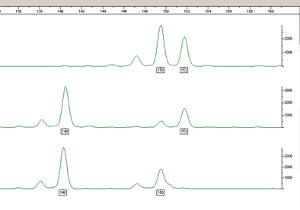
For parentage verification, typically 20 up to 40 genetic characteristics are visualized. In this process the length of genetic fragments is being measured. The measured length of a genetic characteristic in an offspring must correspond to the length in the mother and father that were provided for comparison. In two examples, it is shown how the basic rules are applied in parentage verification.

In the figure an example is provided of a correct parentage. In this figure, the DNA is shown of three individuals: an offspring (upper line), a potential mother (middle line), and a potential father (bottom line). In each line one genetic marker is shown. Two DNA fragments are visible as peaks. The first fragment of the offspring is originating from the father (length of the fragment is 150), whereas the second fragment comes from the mother (fragment length 152). In this case both fragments of the offspring are present in the parents: the parentage is correct.

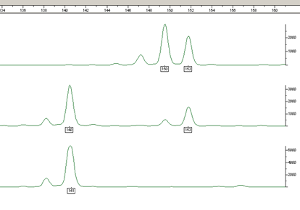
In the second example a situation is shown where parentage does not qualify. The three lines are shown in the order of offspring, potential mother and potential father. Again in each line one DNA marker is shown, where two DNA fragments are visible as peaks. The second fragment of the offspring is present in the mother (fragment length 152), whereas the first fragment in the offspring (fragment length 150) is NOT present at the assigned father. In this case, one fragment is present at the offspring, which is not present in either of the parents: the parentage does not qualify.

When 20 up to 40 different genetic fragments are checked, the chance that an incorrect parentage is not detected becomes very small. The genetic fragments which are used for parentage verification and identification provide no information on properties such as color and quality of an animal, plant or human, since the fragments are non-coding.

When the length of a number of DNA fragments is measured for a sample, a DNA-profile is established. This pattern is unique for a specific individual person, animal or plant, so that in cases of doubt DNA-profiles can be compared to confirm if two samples originate from the same individual.

Introduction to Genetics

History

Since the 19th century experiments have been conducted on the heredity of various organisms. The heredity was determined by observations of organisms – that the next generation gets one copy from each factor from each parent, and subsequently passing the factor on to following generations (Durmaz et al., 2015). The factors include for example colour, height, or shape of the organism. Pioneers Gregor Mendel and Augustinian Friar were scientist studying genetics scientifically. Gregor Mendel performed breeding experiments with hybridizing pea plants, in which different traits were traced. The traits included colour of the plants and round or wrinkled peas. The pioneer, after reporting the first breeding experiments, died in 1884. Little did he know that he would end up in biology textbooks.

Astounding results were observed by Mendel, the scientist saw traits were independently transmitted from each other (Dijk, Weissing, & Ellis, 2018). The independent transmission of traits is based on the position of genes on the corresponding chromosome. The progeny receives half of the chromosomes of both parents. If the gene is positioned on a chromosome – which is not passed down the lineage – the progeny does not express the gene. Therefore, if an experiment is conducted on various traits encoded by the corresponding genes. The progeny expresses different variation of traits in contrast to the parents.

Although, Mendel started the experiments on heredity of organisms. The scientist did not introduce the words “genetics” or “gene”. Later in the 20th, the scientific community century begun to focus on more breeding related experiments, and thereby referring to the results indicated by Mendel. The heredity of organisms would be called “genetics” and the factor that expresses the trait of a species was described as “gene” (Portin, Wilkins, 2017). It was the start of a new discipline in the scientific community.

Introduction to genetics

The introduction of the study genetics leaded to genetic research on a more molecular level. The molecular level experiments were more focussed on the structure and biosynthetic pathways that are needed to express a certain trait. In the first stages of genetic research on various structures and biosynthetic pathways, scientists suggested corresponding proteins were responsible for the induction of the perceived traits. However, following-up research leaded to the – todays well known double helix structured DNA – to be the encoding factor that expresses the perceiving trait.

Nowadays, DNA structures, which have the typical double helix structure, are seen everywhere. Genetic research elucidated more specification on the structure of the DNA strand and stated DNA was an information molecule (Travers & Muskhelishvili, 2015). The DNA strands are made up of so called “nucleic acids”, which are based on four nucleotides adenine (A), thymine (T), cytosine (C) and guanine (G). Groups of nucleic acids, three nucleotides, encode for the amino acids and amino acids are consecutive the basis of entire chromones. As it has been highlighted in modern society are the Homo Sapiens exist of 46 chromosomes. The chromosomes are the building blocks of the human genome.

Mutations and phenotypes

Progressive research broadened the insights on the DNA structures of various species. The DNA structure consists of information molecules, which encode for structural or active biosynthetic systems were the organisms are made up on. Genetic research has indicated changes on the prescribed encoded DNA strand. The changes are called mutations. Mutations are alterations in the DNA strand. The mutations can change a trait such as eye colour, skin colour or height. These traits are all observative characteristics that can be seen by the eye, also called phenotypes. Therefore, when a gene is mutated, the phenotype also changes. Besides, there are non-observative characteristics, which are alternation of the gene that are not visible by the human eye. Mutation for example organ failures, diabetes, or heart defects.

Mutations are commonly experienced as something that should not occur. However, there are multiple outcomes at alternations of DNA, the mutation did not express in a coding region, and therefore no phenotypical changes are witnessed. The alternation has taken place in an active coding region, and subsequently effecting the phenotype of an organism. These are the most common interpretations of DNA alternations.

Implementations of DNA alternations

Implementations of DNA mutations is commonly used in modern society. DNA mutation can be used as genetic markers for the identification of genetic variation, hereditary carriers and dominant inherent. Genetic variation in animals is experienced in everyday life, since every animal has a unique genotype that encodes for a unique phenotype that can be seen. Heredity carriers are more scientifically substantiated as where in the phenotype is not visible by the human eye. In general, the terms recessive and dominant are mostly used. Recessive means the organism has inherited the recessive allele (certain region of DNA) and dominant indicates the organisms has inherited the dominant allele.

The Hereditary carrier

The hereditary carrier is an organism which has inherited a recessive allele for a specific trait, but generally does not express the trait. Although the trait is not expressed by the organism, the organism is able to pass the allele on to the next generation. This way, a specific mutation can be present in multiple generations without noticing. Another possibility is in which the organisms have a dominant inherited allele. When an organism has a dominant and recessive allele for a specific allele, the dominant allele will be expressed. Nevertheless, if a hereditary carrier inherits a recessive allele for the specific trait it carries. This will result in the expression of the inhibited trait.

Punnet Square

The well-known Punnet Square identifies the percentual change of an organism to be homozygote dominant (AA), homozygote recessive (aa) or heterozygote (Aa) (Edwards, 2012). If both parents are carriers and heterozygote the outcome would be 25% homozygote, 25% homozygote and 50% heterozygote. Resulting an allele mutation on the dominate allele would lead to 75% expression on the next generation. However, if the allele mutation was on the recessive allele only 25% of the next generation would express the recessive allele. In addition, spontaneous alternations can also cause genetic variation on alleles, and therefore lead to unexpected results. As for example the Punnet square is used to determine the percentual chance of the lineages genotype. A spontaneous alternation can change a phenotype, for example the hair colour. The linage can have different phenotypes then the ancestors if the breeding continues with the mutation.

Karyotyping

Alleles are specific regions on the chromosome of an organism. The chromosome can be visualized using the technique karyotyping. During karyotyping all the chromosomes are coloured, and subsequently counted and examined using a microscope. Malfunctions in the chromosome assembly can be identified as irregularity of chromosomes or sometimes the number of chromosomes can be reduced or increased. Karyotyping is one of VHLGenetics genotyping techniques.

Business view

VHLGenetics DNA testing is performed at two laboratories. The head office is in Wageningen, the other laboratory is in Germany. DNA tests are performed under various accreditations, certifications, and memberships of organizations such as ICAR and IS. The main goal of VHLGenetics is to provide optimal DNA services for their customers. The core competence is the standardization of work processes in the laboratories. This while remaining flexibility in adding new tests and technologies to the portfolio. The DNA services have been developed from knowledge and experience gained in the last 30 years. DNA services are offered in a wide variety including plants and animals. The service involves mainly KASP, real-time PCR, capillary electrophoresis, and Thermo Fisher Scientific Targeted Genotyping by Sequencing®.

Dominant White 3

White patterning in horses is known as Dominant White or White. Dominant White patterns are variable, ranging from minimal Sabino-like spotting to all-white horses. The eye colour of Dominant White horses is brown. There are about 20 different mutations identified that are associated with white patterns, all mutations are found in the KIT gene. Except for W20, most of the known Dominant White mutations arose recently and are restricted to specific lines within breeds. The Coat Colour Dominant White 3 test (P592) tests for the mutation known as W20 in the KIT gene. This test detects two variants (alleles). The allele W20 is dominant. One or two copies of the W20 allele have a subtle effect on the amount of white expressed. It appears to increase the expression of white in combination with other white pattern genes. The allele N is recessive and does not have an effect on the basic colour.

The Coat Colour Dominant White 3 test encloses the following results, in this scheme the results of the Coat Colour Dominant White 3 test are shown in combination with the possible results for the tests that determine the basic Coat Colour (Coat Colour Chestnut and Coat Colour Agouti test):

Result Dominant White 3

Result Chestnut + Agouti

Coat Colour

Description

N/N

e/e + A/A, A/a or a/a


Chestnut, Sorrel


Not Dominant White. The basic colour chestnut/sorrel is not modified unless modified by other colour modifying genes. It can only pass on allele N to its offspring.

N/N

E/E or E/e + A/A or A/a

Bay, Brown

Not Dominant White. The basic colour bay/brown is not modified unless modified by other colour modifying genes. It can only pass on allele N to its offspring.

N/N

E/E or E/e + a/a

Black

Not Dominant White. The basic colour black is not modified unless modified by other colour modifying genes. It can only pass on allele N to its offspring.

N/W20

e/e + A/A, A/a or a/a


Chestnut/sorrel with Dominant White pattern

Dominant White pattern. One copy of the W20 allele. The horse will display some degree of white spotting but the specific pattern cannot be predicted, unless modified by other colour modifying genes. It can pass on either allele N or W20 to its offspring.

N/W20

E/E or E/e + A/A or A/a

Brown/bay with Dominant White pattern

Dominant White pattern. One copy of the W20 allele. The horse will display some degree of white spotting but the specific pattern cannot be predicted, unless modified by other colour modifying genes. It can pass on either allele N or W20 to its offspring.

N/W20

E/E or E/e + a/a

Black with Dominant White pattern

Dominant White pattern. One copy of the W20 allele. The horse will display some degree of white spotting but the specific pattern cannot be predicted, unless modified by other colour modifying genes. It can pass on either allele N or W20 to its offspring.

W20/W20

e/e + A/A, A/a or a/a

Chestnut/sorrel with Dominant White pattern

Dominant White pattern. Two copies of the W20 allele. The horse will display some degree of white spotting but the specific pattern cannot be predicted, unless modified by other colour modifying genes. It can only pass on allele W20 to its offspring.

W20/W20

E/E or E/e + A/A or A/a

Brown/bay with Dominant White pattern

Dominant White pattern. Two copies of the W20 allele. The horse will display some degree of white spotting but the specific pattern cannot be predicted, unless modified by other colour modifying genes. It can only pass on allele W20 to its offspring.

W20/W20

E/E or E/e + a/a

Black with Dominant White pattern

Dominant White pattern. Two copies of the W20 allele. The horse will display some degree of white spotting but the specific pattern cannot be predicted, unless modified by other colour modifying genes. It can only pass on allele W20 to its offspring.

Sabino 1

Sabino is a general description for a group of similar white spotting patterns. The sabino pattern is described as irregular spotting usually on the legs, belly and face, often with roaning around the edges of the white markings. A mutation has been discovered that produces one type of sabino pattern, it has been named Sabino1 as it is not present in all sabino-patterned horses. More mutations will probably exist that account for other sabino patterns. The Coat Colour Sabino 1 test (P785) tests for the genetic status of the KIT gene. This gene has two variants (alleles). The allele SB1 is semi-dominant. One copy of the SB1 allele results in horses with broken Sabino markings and possibly only a small amount of white. Two copies of the SB1 allele result in at least 90% white, also referred to as Sabino-white. The allele N is recessive and does not have an effect on the basic colour.

The Coat Colour Sabino 1 test encloses the following results, in this scheme the results of the Coat Colour Sabino 1 test are shown in combination with the possible results for the tests that determine the basic Coat Colour (Coat Colour Chestnut and Coat Colour Agouti test):

Result Sabino 1

Result Chestnut + Agouti

Coat Colour

Description

N/N

e/e + A/A, A/a or a/a


Chestnut, Sorrel


Not Sabino 1. The basic colour chestnut/sorrel is not modified unless modified by other colour modifying genes. It can only pass on allele N to its offspring.

N/N

E/E or E/e + A/A or A/a

Bay, Brown

Not Sabino 1. The basic colour bay/brown is not modified unless modified by other colour modifying genes. It can only pass on allele N to its offspring.

N/N

E/E or E/e + a/a

Black

Not Sabino 1. The basic colour is not black modified unless modified by other colour modifying genes. It can only pass on allele N to its offspring.

N/SB1

e/e + A/A, A/a or a/a


Chestnut/sorrel sabino

Sabino 1 pattern. One copy of the SB1 allele. Horse typically may have 2 or more white legs, blaze, spots or roaning in the midsection and jagged margins around white areas unless modified by other colour modifying genes. It can pass on either allele N or SB1 to its offspring.

N/SB1

E/E or E/e + A/A or A/a

Brown/bay sabino

Sabino 1 pattern. One copy of the SB1 allele. Horse typically may have 2 or more white legs, blaze, spots or roaning in the midsection and jagged margins around white areas unless modified by other colour modifying genes. It can pass on either allele N or SB1 to its offspring.

N/SB1

E/E or E/e + a/a

Black sabino

Sabino 1 pattern. One copy of the SB1 allele. Horse typically may have 2 or more white legs, blaze, spots or roaning in the midsection and jagged margins around white areas unless modified by other colour modifying genes. It can pass on either allele N or SB1 to its offspring.

SB1/SB1

e/e + A/A, A/a or a/a


Chestnut/sorrel sabino

Sabino 1 pattern. Two copies of the SB1 allele. Horse is complete or nearly complete white unless modified by other colour modifying genes. It can only pass on allele SB1 to its offspring.

SB1/SB1

E/E or E/e + A/A or A/a

Brown/bay sabino

Sabino 1 pattern. Two copies of the SB1 allele. Horse is complete or nearly complete white unless modified by other colour modifying genes. It can only pass on allele SB1 to its offspring.

SB1/SB1

E/E or E/e + a/a

Black sabino

Sabino 1 pattern. Two copies of the SB1 allele. Horse is complete or nearly complete white unless modified by other colour modifying genes. It can only pass on allele SB1 to its offspring.

Distrofia Muscolare Congenita (CMD) – Piccolo levriero italiano (Italian Greyhound)

La distrofia muscolare congenita (CMD o MD) è un disturbo muscolare che causa atrofia e scarsa crescita. Questa particolare variante della malattia è causata da una mutazione recessiva del gene LAMA2. La variante analizzata in questi test si verifica nel levriero italiano. Una variante correlata si verifica anche nello Staffordshire Bull Terrier.

Tobiano

The Tobiano coat pattern usually involves white on all four legs below the hocks and knees and rounded white spots on the body with sharp, clean edges. The head is dark, with white markings like those of a solid colored horse. The white on the body will generally cross the top-line of the horse. The skin underlying the white spots is pink and under the colored areas it is black. The eyes are usually brown, but one or both may be blue or partially blue. The tail can be two colors, a characteristic seldom seen in horses that are not tobiano. A horse can also carry mutations for other modifying genes which can further affect its coat colour.

The Coat Colour Tobiano test (P903) tests for a genetic factor that affects the function of the KIT gene. This gene has two variants (alleles). The dominant allele TO results in the Tobiano pattern and the recessive allele N does not have an effect on the basic colour.

The Coat Colour Tobiano test encloses the following results, in this scheme the results of the Coat Colour Tobiano test are shown in combination with the possible results for the tests that determine the basic Coat Colour (Coat Colour Chestnut and Coat Colour Agouti test):

Result Tobiano

Result Chestnut + Agouti

Coat Colour

Description

N/N

e/e + A/A, A/a or a/a


Chestnut, Sorrel


Not Tobiano. The basic colour chestnut/sorrel is not modified unless modified by other colour modifying genes. It can only pass on allele N to its offspring.

N/N

E/E or E/e + A/A or A/a

Bay, Brown

Not Tobiano. The basic colour bay/brown is not modified unless modified by other colour modifying genes. It can only pass on allele N to its offspring.

N/N

E/E or E/e + a/a

Black

Not Tobiano. The basic colour black is not modified unless modified by other colour modifying genes. It can only pass on allele N to its offspring.

N/TO

e/e + A/A, A/a or a/a


Chestnut/sorrel tobiano

One copy of the dominant TO allele. The colour is chestnut/sorrel tobiano unless modified by other colour modifying genes. It can pass on either allele N or TO to its offspring.

N/TO

E/E or E/e + A/A or A/a

Bay/brown tobiano

One copy of the dominant TO allele. The colour is bay/brown tobiano unless modified by other colour modifying genes. It can pass on either allele N or TO to its offspring.

N/TO

E/E or E/e + a/a

Black tobiano

One copy of the dominant TO allele. The colour is black tobiano unless modified by other colour modifying genes. It can pass on either allele N or TO to its offspring.

TO/TO

e/e + A/A, A/a or a/a


Chestnut/sorrel tobiano

Two copies of the dominant TO allele. The colour is chestnut/sorrel tobiano unless modified by other colour modifying genes. It can only pass on allele TO to its offspring.

TO/TO

E/E or E/e + A/A or A/a

Bay/brown tobiano

Two copies of the dominant TO allele. The colour is bay/brown tobiano unless modified by other colour modifying genes. It can only pass on allele TO to its offspring.

TO/TO

E/E or E/e + a/a

Black tobiano

Two copies of the dominant TO allele. The colour is black tobiano unless modified by other colour modifying genes. It can only pass on allele TO to its offspring.

Dominant White 1

White patterning in horses is known as Dominant White or White. Dominant White patterns are variable, ranging from minimal Sabino-like spotting to all-white horses. The eye colour of Dominant White horses is brown. There are about 20 different mutations identified that are associated with white patterns, all mutations are found in the KIT gene. Except for W20, most of the known Dominant White mutations arose recently and are restricted to specific lines within breeds. The Coat Colour Dominant White 1 test (P591) tests for the mutation known as W18 in the KIT gene. This test detects two variants (alleles). The allele W18 is dominant. One or two copies of the W18 allele result in horses that display some degree of white spotting but the specific pattern cannot be predicted. The allele N is recessive and does not have an effect on the basic colour.

The Coat Colour Dominant White 1 test encloses the following results, in this scheme the results of the Coat Colour Dominant White 1 test are shown in combination with the possible results for the tests that determine the basic Coat Colour (Coat Colour Chestnut and Coat Colour Agouti test):

Result Dominant White 1

Result Chestnut + Agouti

Coat Colour

Description

N/N

e/e + A/A, A/a or a/a


Chestnut, Sorrel


Not Dominant White. The basic colour chestnut/sorrel is not modified unless modified by other colour modifying genes. It can only pass on allele N to its offspring.

N/N

E/E or E/e + A/A or A/a

Bay, Brown

Not Dominant White. The basic colour bay/brown is not modified unless modified by other colour modifying genes. It can only pass on allele N to its offspring.

N/N

E/E or E/e + a/a

Black

Not Dominant White. The basic colour black is not modified unless modified by other colour modifying genes. It can only pass on allele N to its offspring.

N/W18

e/e + A/A, A/a or a/a


Chestnut/sorrel with Dominant White pattern

Dominant White pattern. One copy of the W18 allele. The horse will display some degree of white spotting but the specific pattern cannot be predicted, unless modified by other colour modifying genes. It can pass on either allele N or W18 to its offspring.

N/W18

E/E or E/e + A/A or A/a

Brown/bay with Dominant White pattern

Dominant White pattern. One copy of the W18 allele. The horse will display some degree of white spotting but the specific pattern cannot be predicted, unless modified by other colour modifying genes. It can pass on either allele N or W18 to its offspring.

N/W18

E/E or E/e + a/a

Black with Dominant White pattern

Dominant White pattern. One copy of the W18 allele. The horse will display some degree of white spotting but the specific pattern cannot be predicted, unless modified by other colour modifying genes. It can pass on either allele N or W18 to its offspring.

W18/W18

e/e + A/A, A/a or a/a

Chestnut/sorrel with Dominant White pattern

Dominant White pattern. Two copies of the W18 allele. The horse will display some degree of white spotting but the specific pattern cannot be predicted, unless modified by other colour modifying genes. It can only pass on allele W18 to its offspring.

W18/W18

E/E or E/e + A/A or A/a

Brown/bay with Dominant White pattern

Dominant White pattern. Two copies of the W18 allele. The horse will display some degree of white spotting but the specific pattern cannot be predicted, unless modified by other colour modifying genes. It can only pass on allele W18 to its offspring.

W18/W18

E/E or E/e + a/a

Black with Dominant White pattern

Dominant White pattern. Two copies of the W18 allele. The horse will display some degree of white spotting but the specific pattern cannot be predicted, unless modified by other colour modifying genes. It can only pass on allele W18 to its offspring.

Cream dilution

The cream dilution gene has an effect on both red and black pigment and dilutes the basic coat colour to lighter coat shades. In several breeds this is considered a desirable trait. The Cream dilution gene is responsible for the palomino, buckskin, smoky black, cremello, perlino and smoky cream coat colours. A horse can also carry mutations for other modifying genes which can further affect its coat colour. The Coat Colour Cream dilution test (P713) tests for the genetic status of the MATP gene. The MATP gene has two variants (alleles). The allele Cr is semi-dominant. One copy of the Cr allele dilutes the coat colour with a single dose, resulting in palomino, buckskin or smoky black. Two copies of the Cr allele dilute the coat colour with a double dose into cremello, perlino or smoky cream. The effect on black pigment might be very subtle. Horses with two copies of the Cr allele are also called “double-dilutes” or “blue-eyed cream” and they share a number of characteristics. The eyes are pale blue, paler than the unpigmented blue eyes associated with white color or white markings, and the skin is rosy-pink. The allele N is recessive and does not have an effect on the basic colour.

The Coat Colour Cream dilution test encloses the following results, in this scheme the results of the Coat Colour Cream dilution test are shown in combination with the possible results for the tests that determine the basic Coat Colour (Coat Colour Chestnut and Coat Colour Agouti test):

Result Cream dilution

Result Chestnut + Agouti

Coat Colour

Description

N/N

e/e + A/A, A/a or a/a


Chestnut, Sorrel

Non-dilute. The basic colour is chestnut or sorrel unless modified by other colour modifying genes. It can only pass on allele N to its offspring.

N/N

E/E or E/e + A/A or A/a

Bay, Brown

Non-dilute. The basic colour is bay or brown unless modified by other colour modifying genes. It can only pass on allele N to its offspring.

N/N

E/E or E/e + a/a

Black

Non-dilute. The basic colour is black unless modified by other colour modifying genes. It can only pass on allele N to its offspring.

N/Cr

e/e + A/A, A/a or a/a


Palomino


Heterozygous dilute, one copy of the Cr allele. The basic coat colour chestnut/sorrel is diluted to palomino. These colours can be further modified by other colour modifying genes. It can pass on either allele N or Cr to its offspring.

N/Cr

E/E or E/e + A/A or A/a

Buckskin

Heterozygous dilute, one copy of the Cr allele. The basic coat colour bay/brown is diluted to buckskin. These colours can be further modified by other colour modifying genes. It can pass on either allele N or Cr to its offspring.

N/Cr

E/E or E/e + a/a

Smoky Black

Heterozygous dilute, one copy of the Cr allele. The basic coat colour black is diluted to Smoky Black. These colours can be further modified by other colour modifying genes. It can pass on either allele N or Cr to its offspring.

Cr/Cr

e/e + A/A, A/a or a/a


Cremello


Double dilute, two copies of the Cr allele. The basic coat colour chestnut/sorrel is diluted to Cremello. These colours can be further modified by other colour modifying genes. It can only pass on allele Cr to its offspring.

Cr/Cr

E/E or E/e + A/A or A/a

Perlino

Double dilute, two copies of the Cr allele. The basic coat colour bay/brown is diluted to Perlino. These colours can be further modified by other colour modifying genes. It can only pass on allele Cr to its offspring.

Cr/Cr

E/E or E/e + a/a

Smoky Cream

Double dilute, two copies of the Cr allele. The basic coat colour black is diluted to Smoky Cream. These colours can be further modified by other colour modifying genes. It can only pass on allele Cr to its offspring.

Champagne dilution

The Champagne dilution gene lightens the coat colour of the horse by diluting the pigment. The skin of Champagne-diluted horses is pinkish/lavender toned and becomes speckled with age; the speckling is particularly noticeable around the eye, muzzle, under the tail, udder and sheath. The eye colour is blue-green at birth and darkens to amber as the horse ages. Champagne has the following effects on the basic coat colours of horses:

Chestnut/Sorrel -> Gold champagne:   a gold body color and often a flaxen mane and tail. Gold champagne horses are visually similar to palomino horses.

Bay/Brown -> Amber champagne:       a tan body color with brown points (sometimes referred to as amber Buckskin).

Black -> Classic champagne:               a darker tan body with brown points.

A horse can also carry mutations for other modifying genes which can further affect its coat colour. The Coat Colour Champagne dilution test (P853) tests for the genetic status of the SLC36A1 gene. This gene has two variants (alleles). The dominant allele Ch results in the dilution and the recessive allele N does not have an effect on the basic colour.

The Coat Colour Champagne dilution test encloses the following results, in this scheme the results of the Coat Colour Champagne dilution test are shown in combination with the possible results for the tests that determine the basic Coat Colour (Coat Colour Chestnut and Coat Colour Agouti test):

Result Champagne dilution

Result Chestnut + Agouti

Coat Colour

Description

N/N

e/e + A/A, A/a or a/a


Chestnut, Sorrel


Non-dilute. The basic colour chestnut/sorrel is not modified unless modified by other colour modifying genes. It can only pass on allele N to its offspring.

N/N

E/E or E/e + A/A or A/a

Bay, Brown

Non-dilute. The basic colour bay/brown is not modified unless modified by other colour modifying genes. It can only pass on allele N to its offspring.

N/N

E/E or E/e + a/a

Black

Non-dilute. The basic colour black is not modified unless modified by other colour modifying genes. It can only pass on allele N to its offspring.

N/Ch

e/e + A/A, A/a or a/a


Gold Champagne


One copy of the dominant Ch allele. The basic colour chestnut/sorrel is diluted to gold champagne unless modified by other colour modifying genes. It can pass on either allele N or Ch to its offspring.

N/Ch

E/E or E/e + A/A or A/a

Amber Champagne

One copy of the dominant Ch allele. The basic colour bay/brown is diluted to amber champagne unless modified by other colour modifying genes. It can pass on either allele N or Ch to its offspring.

N/Ch

E/E or E/e + a/a

Classic Champagne

One copy of the dominant Ch allele. The basic colour black is diluted to classic champagne unless modified by other colour modifying genes. It can pass on either allele N or Ch to its offspring.

Ch/Ch

e/e + A/A, A/a or a/a


Gold Champagne


Two copies of the dominant Ch allele. The basic colour chestnut/sorrel is diluted to Gold Champagne unless modified by other colour modifying genes. It can only pass on allele Ch to its offspring.

Ch/Ch

E/E or E/e + A/A or A/a

Amber Champagne

Two copies of the dominant Ch allele. The basic colour bay/brown is diluted to amber champagne unless modified by other colour modifying genes. It can only pass on allele Ch to its offspring.

Ch/Ch

E/E or E/e + a/a

Classic Champagne

Two copies of the dominant Ch allele. The basic colour black is diluted to classic champagne unless modified by other colour modifying genes. It can only pass on allele Ch to its offspring.

Pearl dilution

The Pearl dilution gene lightens the coat colour of the horse by diluting the red pigment. A chestnut basic colour is diluted to a pale, uniform apricot colour of body, mane and tail. Skin coloration is also pale. Pearl dilution is also referred to as the ‘Barlink Factor.’ The Coat Colour Pearl dilution test (P783) tests for the genetic status of the SLC45A2 gene. This gene has two variants (alleles). The allele Prl, causing the Pearl dilution is recessive. This means that only horses with two copies of the Prl allele have a lightened coat, mane and tail, in addition to bright eye colors. The dominant allele N does not have an effect on the basic coat colour.

Pearl dilution interacts with Cream dilution to produce pseudo-double dilute phenotypes including pale skin and blue/green eyes. Therefore if a horse has one copy of the Prl allele and Cream dilution (Cr allele) is also present, this results in a pseudo-double dilute, also called pseudo-cremellos or pseudo-smoky cream

A horse can also carry mutations for other modifying genes which can further affect its coat colour.

The Coat Colour Pearl dilution test encloses the following results, in this scheme the results of the Coat Colour Pearl dilution test are shown in combination with the possible results for the tests that determine the basic Coat Colour (Coat Colour Chestnut and Coat Colour Agouti test):

Result Pearl dilution

Result Chestnut + Agouti

Coat Colour

Description

N/N

e/e + A/A, A/a or a/a

Chestnut, Sorrel

Non-dilute. The basic colour chestnut/sorrel is not diluted unless modified by other colour modifying genes. It can only pass on allele N to its offspring.

N/N

E/E or E/e + A/A or A/a

Bay, Brown

Non-dilute. The basic colour bay/brown is not diluted unless modified by other colour modifying genes. It can only pass on allele N to its offspring

N/N

E/E or E/e + a/a

Black

Non-dilute. The basic colour black is not diluted unless modified by other colour modifying genes. It can only pass on allele N to its offspring

N/Prl

e/e + A/A, A/a or a/a


Chestnut, Sorrel

One copy of the recessive Prl allele. The basic colour chestnut/sorrel is not diluted unless modified by other colour modifying genes. If cream dilution is also present, this results in a pseudo-double dilute. It can pass on either allele N or Prl to its offspring.

N/Prl

E/E or E/e + A/A or A/a

Bay, Brown

One copy of the recessive Prl allele. The basic colour bay/brown is not diluted unless modified by other colour modifying genes. If cream dilution is also present, this results in a pseudo-double dilute. It can pass on either allele N or Prl to its offspring.

N/Prl

E/E or E/e + a/a

Black

One copy of the recessive Prl allele. The basic colour black not diluted unless modified by other colour modifying genes. If cream dilution is also present, this results in a pseudo-double dilute. It can pass on either allele N or Prl to its offspring.

Prl/Prl

e/e + A/A, A/a or a/a


Pearl dilution

Two copies of the recessive Prl allele. The basic colour chestnut/sorrel is diluted to a pale, uniform apricot colour of body hair, mane and tail. This colour can be further modified by other colour modifying genes. It can only pass on allele Prl to its offspring.

Prl/Prl

E/E or E/e + A/A or A/a

Pearl dilution

Two copies of the recessive Prl allele. The basic colour bay/brown is diluted to lightened coat, mane and tail. This colour can be further modified by other colour modifying genes. It can only pass on allele Prl to its offspring.

Prl/Prl

E/E or E/e + a/a

Pearl dilution

Two copies of the recessive Prl allele. The basic colour black is diluted to lightened coat, mane and tail. This colour can be further modified by other colour modifying genes. It can only pass on allele Prl to its offspring.

Silver dilution / MCOA

The Silver dilution gene dilutes the black pigment but has no effect on the red pigment. The effect of the Silver dilution gene can vary greatly. The mane and tail are lightened to flaxen or silver gray, and may darken on some horses as they age. A black horse will be diluted to chocolate with a lightened mane and tail. A Bay horse with Silver dilution will usually have a lightened mane and tail, as well as lightened lower legs (places with black pigment). A horse can also carry mutations for other modifying genes which can further affect its coat colour.

The Coat Colour Silver dilution test (P784) tests for the genetic status of the PMEL17 gene. This gene has two variants (alleles). The dominant allele Z results in the dilution and the recessive allele N does not have an effect on the basic colour.

The same mutation responsible for the coat color Silver is also associated with Multiple Congenital Ocular Anomalies (MCOA) Syndrome, a wide range of ocular defects that occur in the anterior and posterior parts of the eye. The severity of the syndrome is dose related, so horses with 1 copy of allele Z have fewer severe signs than those with 2 copies of allele Z.

The Coat Colour Silver dilution test encloses the following results, in this scheme the results of the Coat Colour Silver dilution test are shown in combination with the possible results for the tests that determine the basic Coat Colour (Coat Colour Chestnut and Coat Colour Agouti test):

Result Silver dilution

Result Chestnut + Agouti

Coat Colour

Description

N/N

e/e + A/A, A/a or a/a


Chestnut, Sorrel


Non-dilute. The basic colour chestnut/sorrel is not modified unless modified by other colour modifying genes. It can only pass on allele N to its offspring.

N/N

E/E or E/e + A/A or A/a

Bay, Brown

Non-dilute. The basic colour bay/brown is not modified unless modified by other colour modifying genes. It can only pass on allele N to its offspring.

N/N

E/E or E/e + a/a

Black

Non-dilute. The basic colour black is not modified unless modified by other colour modifying genes. It can only pass on allele N to its offspring.

N/Z

e/e + A/A, A/a or a/a


Chestnut, Sorrel


One copy of the dominant Z allele. The basic colour chestnut/sorrel is not modified unless modified by other colour modifying genes. It can pass on either allele N or Z to its offspring.

N/Z

E/E or E/e + A/A or A/a

Silver dilution on Bay or Brown

One copy of the dominant Z allele. The black pigment of bay/brown horses on lower legs is lightened and mane and tail are lightened to flaxen. The colour can be further modified by other colour modifying genes. It can pass on either allele N or Z to its offspring.

N/Z

E/E or E/e + a/a

Chocolate

One copy of the dominant Z allele. The basic colour black is diluted to chocolate with flaxen mane and tail. The colour can be further modified by other colour modifying genes. It can pass on either allele N or Z to its offspring.

Z/Z

e/e + A/A, A/a or a/a


Chestnut, Sorrel


Two copies of the dominant Z allele. The basic colour chestnut/sorrel is not modified unless modified by other colour modifying genes. It can only pass on allele Z to its offspring.

Z/Z

E/E or E/e + A/A or A/a

Silver dilution on Bay or Brown

Two copies of the dominant Z allele. The black pigment of bay/brown horses on lower legs is lightened and mane and tail are lightened to flaxen. The colour can be further modified by other colour modifying genes. It can only pass on allele Z to its offspring.

Z/Z

E/E or E/e + a/a

Chocolate

Two copies of the dominant Z allele. The basic colour black is diluted to chocolate with flaxen mane and tail. The colour can be further modified by other colour modifying genes. It can only pass on allele Z to its offspring.

Splashed White 3

Splashed white is a variable white spotting pattern characterized by a large blaze, extended white markings on legs, variable white spotting on belly, pink skin and often blue eyes. In other cases, the unpigmented areas are quite small and cannot be distinguished from horses with other more subtle depigmentation phenotypes. Splashed white horses are sometimes deaf, however most splashed white horses are not deaf. Hearing loss is due to the death of the necessary hair cells, caused by the absence of melanocytes in the inner ear. Although the majority of splash horses have pigment around the outside of the ear, the pigment must occur in the inner ear to prevent hearing loss. There are several different mutations identified that are associated with splashed white patterns. The Coat White Spotting 3 test (P514) tests for the mutation known as SW3 in the MITF gene. This test detects two variants (alleles). The allele SW3 is dominant. One or two copies of the SW3 allele result in splashed white. It is speculated that two copies of the SW3 allele are lethal (the foal dies). The allele N is recessive and does not have an effect on the basic colour.

The Coat Colour White Spotting 3 test encloses the following results, in this scheme the results of the Coat Colour White Spotting 3 test are shown in combination with the possible results for the tests that determine the basic Coat Colour (Coat Colour Chestnut and Coat Colour Agouti test):

Result White Spotting 3

Result Chestnut + Agouti

Coat Colour

Description

N/N

e/e + A/A, A/a or a/a


Chestnut, Sorrel


Not Splashed White. The basic colour chestnut/sorrel is not modified unless modified by other colour modifying genes. It can only pass on allele N to its offspring.

N/N

E/E or E/e + A/A or A/a

Bay, Brown

Not Splashed White The basic colour bay/brown is not modified unless modified by other colour modifying genes. It can only pass on allele N to its offspring.

N/N

E/E or E/e + a/a

Black

Not Splashed White. The basic colour black is not modified unless modified by other colour modifying genes. It can only pass on allele N to its offspring.

N/SW3

e/e + A/A, A/a or a/a


Chestnut/sorrel with Splashed White pattern

Splashed White pattern. One copy of the SW3 allele. The horse will display some degree of white spotting but the specific pattern cannot be predicted, unless modified by other colour modifying genes. It can pass on either allele N or SW3 to its offspring.

N/SW3

E/E or E/e + A/A or A/a

Brown/bay with Splashed White pattern

Splashed White pattern. One copy of the SW3 allele. The horse will display some degree of white spotting but the specific pattern cannot be predicted, unless modified by other colour modifying genes. It can pass on either allele N or SW3 to its offspring.

N/SW3

E/E or E/e + a/a

Black with Splashed White pattern

Splashed White pattern. One copy of the SW3 allele. The horse will display some degree of white spotting but the specific pattern cannot be predicted, unless modified by other colour modifying genes. It can pass on either allele N or SW3 to its offspring.

SW3/SW3

e/e + A/A, A/a or a/a

Chestnut/sorrel with Splashed White pattern

Splashed White pattern. Two copies of the SW3 allele. The horse will display some degree of white spotting but the specific pattern cannot be predicted, unless modified by other colour modifying genes. It can only pass on allele SW3 to its offspring.

SW3/SW3

E/E or E/e + A/A or A/a

Brown/bay with Splashed White pattern

Splashed White pattern. Two copies of the SW3 allele. The horse will display some degree of white spotting but the specific pattern cannot be predicted, unless modified by other colour modifying genes. It can only pass on allele SW3 to its offspring.

SW3/SW3

E/E or E/e + a/a

Black with Splashed White pattern

Splashed White pattern. Two copies of the SW3 allele. The horse will display some degree of white spotting but the specific pattern cannot be predicted, unless modified by other colour modifying genes. It can only pass on allele SW3 to its offspring.

Go to Top